
Blog
Encouragement and insights for the journey ahead.
By Emily Miller
M.A. (Marriage & Family Therapy), LAC
Love That Lasts
Love That Lasts: What the Gottman Method Can Teach Us About Relationships
Science-backed tools for real-life connection.
What if there was actual research— like, decades worth —that could help couples build a healthier, happier, and more resilient relationship?
Good news: there is!
It’s called the Gottman Method. It’s a relationship model created by Drs. John and Julie Gottman, based on over 40 years of studying real couples in real life. We're talking arguments, affection, eye-rolls, and everything in between.
They didn’t just guess what made couples thrive, they studied it. And they found patterns that can predict whether a couple stays together or drifts apart with more than 90% accuracy.
But don’t worry, this isn’t a doom-and-gloom model. It’s a hopeful, practical, and compassionate roadmap to building connection that lasts.
The Heart of the Gottman Method: Connection Over Correction
At its core, the Gottman Method isn’t about changing your partner. It’s about changing the way you show up with them. Especially during conflict, disconnection, or day-to-day stress.
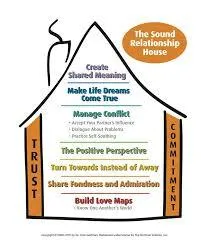
It’s built around what the Gottmans call the Sound Relationship House. A framework of 7 key elements that strong, loving couples tend to practice.
The Sound Relationship House: Your Relationship’s Blueprint
Here’s what it looks like, from foundation to rooftop:
1️) Build Love Maps
This means really knowing your partner. Their inner world, their hopes, fears, likes, dislikes, and what kind of week they’ve had.
Ask each other:
“What’s been stressing you out lately?”
“What’s something you’re excited about?”
“What’s a small way I can support you this week?”
2️) Share Fondness and Admiration
Notice the good. Express appreciation. Catch them doing something right.
Instead of “You never help,” try “Thank you for unloading the dishwasher. It helped more than you know.”
Small moments of kindness build big trust.
3️) Turn Toward Instead of Away
When your partner makes a “bid” for connection (like a comment, a sigh, a story, or even a silly meme) turn toward them.
Respond. Acknowledge. Show interest.
Because love isn’t built in grand gestures. It’s built in micro-moments.
4️) Let Your Partner Influence You
Healthy relationships are partnerships, not power plays.
Letting your partner’s needs and perspectives shape your decisions builds mutual respect.
This doesn’t mean giving in. It means making space for both of you to matter.
5️) Solve Solvable Problems
Some conflicts are fixable with communication and compromise.
For those issues, Gottman recommends:
Soft start-ups (“I feel” instead of “You always…”)
Taking breaks if emotions spike
Looking for win-win solutions
Hint: The goal is understanding, not being “right.”
6️) Manage Conflict (Don’t Eliminate It)
All couples fight. Even the best ones.
What matters is how you fight.
The Gottmans warn against the Four Horsemen of the Apocalypse: behaviors that corrode relationships:
Criticism
Contempt
Defensiveness
Stonewalling
But they also offer antidotes:
Use “I” statements
Build a culture of appreciation
Take responsibility
Practice self-soothing
7️) Create Shared Meaning
Healthy couples don’t just survive together, they grow together. They create rituals, traditions, and shared goals. Whether it’s Friday pizza night, spiritual practices, or how you parent, meaning matters.
Ask:
“What legacy do we want to leave as a couple?”
“What makes us… us?”
Practical Ways to Start Using the Gottman Method Today
You don’t need to overhaul your whole relationship in a weekend. Try starting with:
A weekly “state of the union” check-in
A daily 6-second kiss (yes, really — the Gottmans recommend this!)
A journal where you each write one appreciation per day
Practicing turning toward your partner at least once per day
Takeaway: It’s Not About Perfection. It’s About Practice
Relationships aren’t built in the big moments. They’re built in the tiny, everyday interactions.
The sighs. The glances. The coffee cups left out. The laughs shared in the car.
The Gottman Method reminds us: You don’t need to be perfect. You just need to keep showing up, keep turning toward, and keep choosing your person again and again.
Because love isn’t something we fall into, it’s something we build.
And with the right tools it gets stronger every day.

Start Your Journey Today
Begin your journey towards a happier and more fulfilling life today.

At Exhale, we believe everyone has power to create the life they desire.
This is a supervised private practice. It is owned and managed by a master’s-level, non-independent licensee under Board-approved clinical supervision pursuant to A.A.C. R4-6-211. The Board approved clinical supervisor of this practice is:
Name: Rachel Sommerfield, LPC, MC, ADHD-CP
Phone: (520)509-5371
Email: [email protected]

© 2025 . All rights reserved.
Facebook
Instagram
TikTok